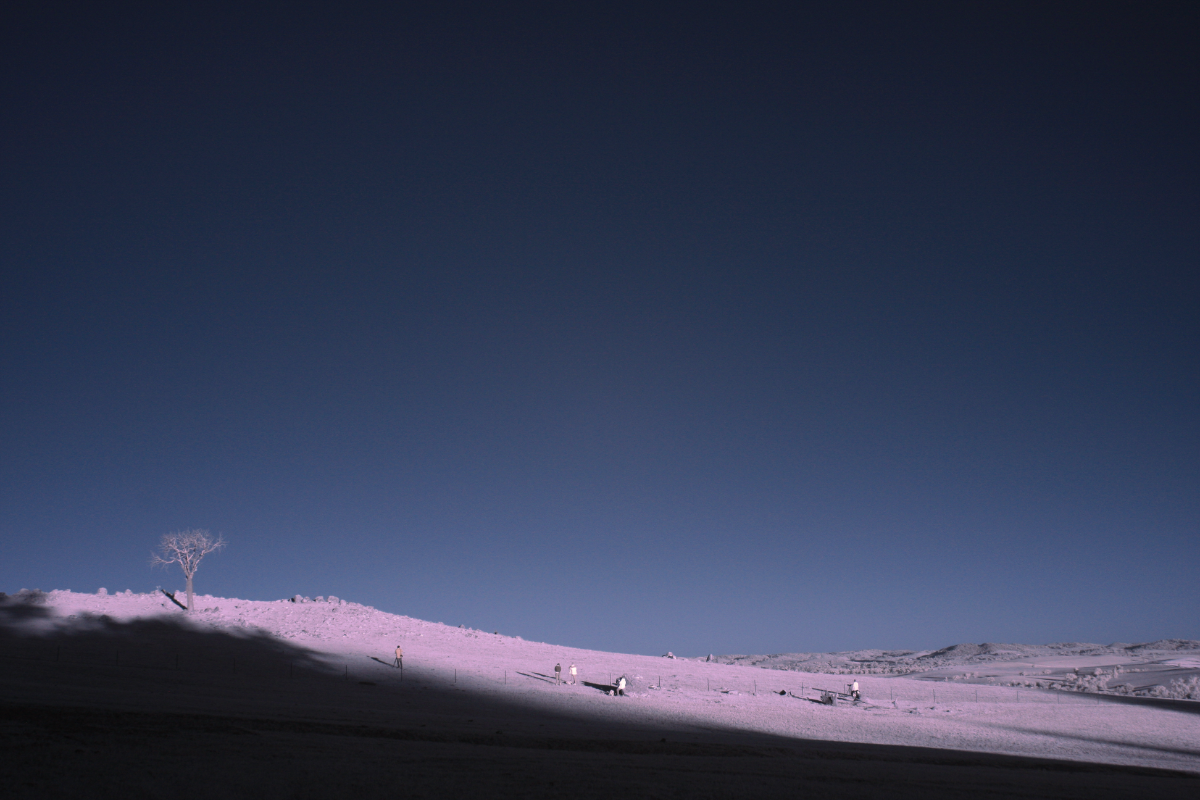
Welcome to my infrared gallery. These images are all taken with some specialist gear that allows me to shoot photos using light that's basically outside the usual visible spectrum. In short, it's an interesting way to "see" things in ways we simply can't see. In that regard, all IR (and UV for that matter) photographs are "false" in a way.
If you don't know, infrared (IR) is a range of light frequencies (or colours) that starts just outside the red end of our visible spectrum. However, because the whole IR spectrum is far wider than our visible range (red, orange, yellow, green, blue, indigo, and violet), it's nearly impossible to focus as sharply as everyday photos... unless we use filters that only allow a narrow range of IR wavelengths.
Challenges with Infrared (IR)
You can't see IR
In order to shoot IR images, you have to exclude visible light. This poses three problems:
- If you're using a camera with an IR filter on the lens, you can't see anything for composition, exposure or focusing.
- Many cameras have an IR blocking filter on the sensor so typical visible spectrum shots are sharper and colour accurate. So if you're blocking IR on the sensor, and blocking the visible spectrum with a filter on the lens, then you have very little light to work with. Now, no filter is perfect, and some light always gets through, but this means long and slow shutter speeds, making motion blur, and noise more of an issue.
- A lot of lenses have anti-reflective coatings on each element (fancy name for the various pieces of shaped glass/plastic that gathers and focuses light in the lens). However, these coatings are designed to stop reflections in the visible spectrum, not IR... so many lenses, even good ones, can suffer from flare and "hot spots" (bright areas in the image) which degrade image quality.
Autofocus stops working for IR
IR often confuses the autofocus system that everyone uses so frequently with visible light. The IR wavelengths themselves are far longer (say the size of a pin tip, which we can see unaided by microscopes)... as opposed to the microscopic (bacteria sized) wavelengths our visible range tends to have. When wavelengths are different, the same lens will bend them to differing angles. As such, IR needs to be focused differently than visible light, so IR work needs the focus system to have two things calibrated:
- The offset for the most common wavelengths of IR (this depends on your IR filter)
- The focal length needs to be fixed (no zoom capability, or lens changing, as this will throw the calibration off).
Interestingly, heat is also in the range of (albeit) far infrared which is how "thermographic" cameras work. However, before you get confused, this form of IR photography is limited to the "near infrared" range, which has little if anything to do with heat.