
Is the "Sunday drive" still a thing? If not, it really should be!
Honestly, I don't really know. I think it was more common (at least here in Australia) in my parents and grandparents day. That said, a lot of people take their kids out to various festivals, sporting matches, and camping trips... which seem a little more specific in destination.
In case you don't know...
The Sunday drive (long associated with people driving too slowly) was just a cheap way to see whatever is down "that road" or "over that hill" or "around that bend". There wasn't really a specific destination, and the uncertainty was half the fun of it. Truthfully though, we were intending to see (and photograph) the views from one of the back roads of a nearby lake... we found the lake, but not the part we were looking for. So we drove along the shore line in the opposite direction (the road didn't go the other way), just because we could.
We found fruit trees along the road, Eagles, black swans, colourful parrots, and pretty green.... smaller birds (whatever they are), a wallaby (small kangaroo) with her joey (baby) sticking it's face out of the pouch, and even a wild echidna! Oh, and we found self-delivering Fudge. Which I'll explain below...
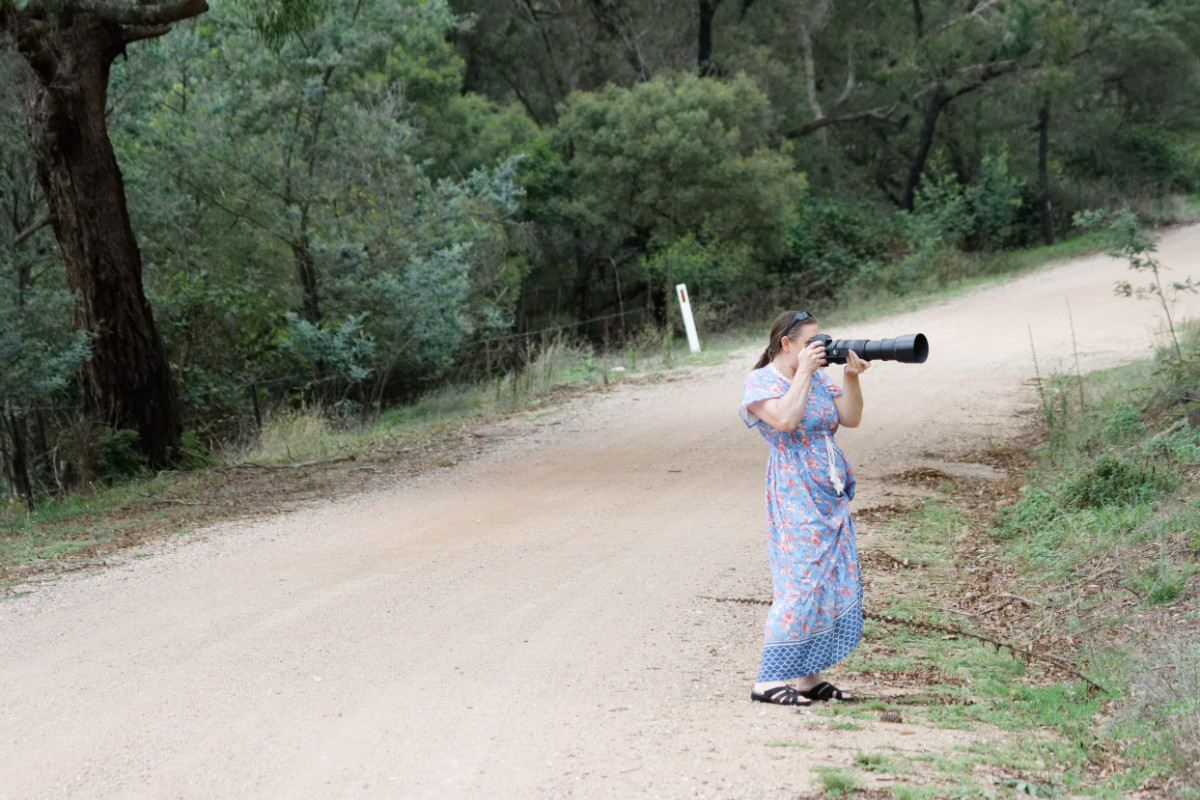
Overdressed for the occasion.
Believe it or not, we'd gone out with the intention of visiting an art exhibition, (which we did) then just decided to do some "photographic reconaissance" by heading toward that lake I mentioned earlier. We had this image of the area like dirt roads running right up to our (presumed) destination, and we'd just have a quick look around. So we didn't exactly pack another set of clothes.
However, with only the road turning the other way, "all bets were off" about what to expect, so here's Ren, dressed in her slightly more formal-than-needed dress, weilding her Canon, attached to what we call "The Bigma" a Sigma 150-500mm telephoto lens that she's had for a very long time. We weren't going to venture off the road, so we were simply trying to get photos, either from inside the car, or walking (as quietly as possible on gravel) to get a better vantage.

Camouflaged it is not... but that still doesn't mean a good shot is easy!
Sometimes you have to wonder how such brightly coloured creatures survive in the wild. I mean, it's not like it's hard to find this male Crimson Rosella.
This is the best shot I got of him as the car crawled past. The autofocus system had trouble because all the stalks kept getting in the way. So this I had to do the focus manually. But it's a good sign that we might see some other birds in the area.
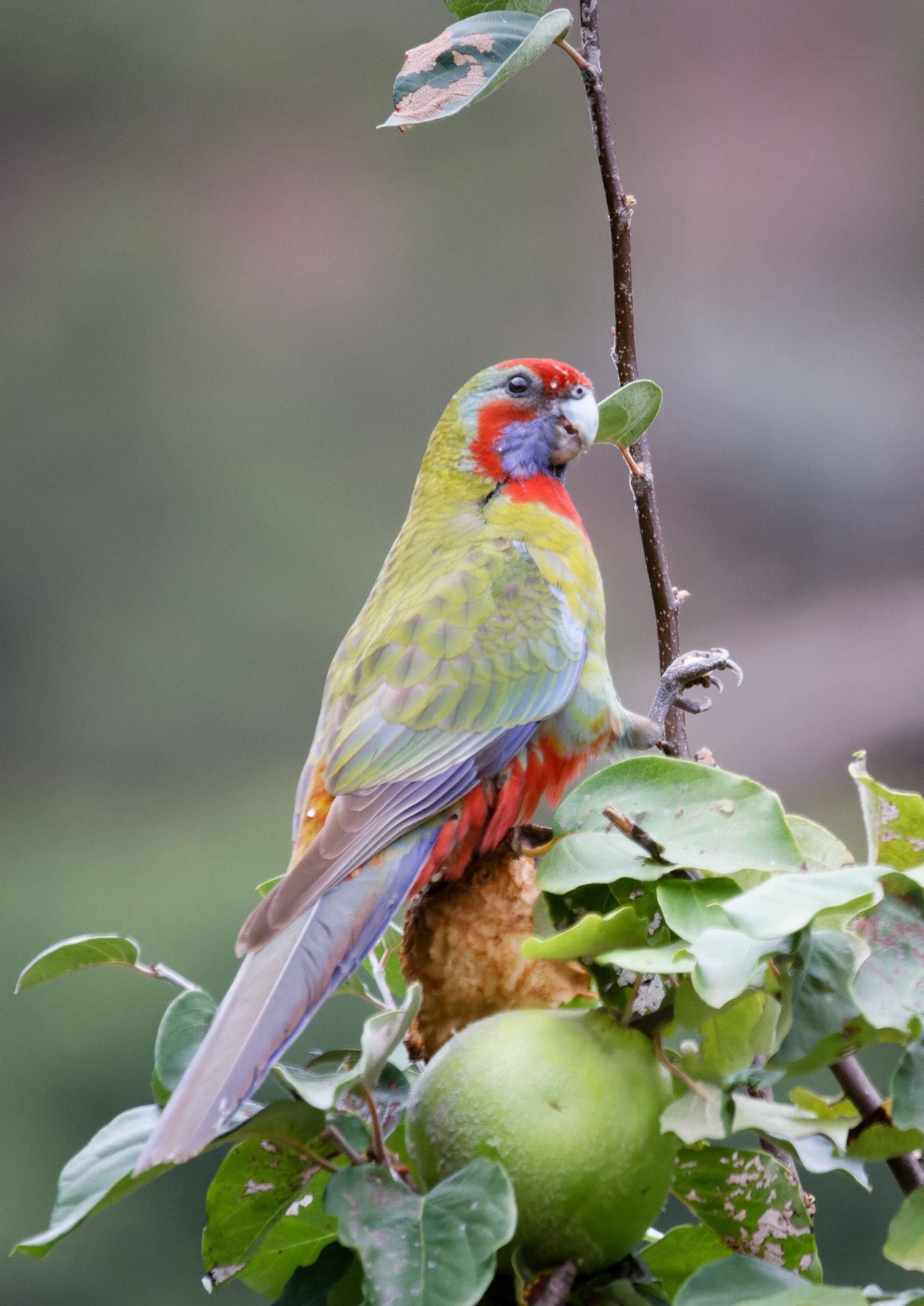
You never know what you'll find on a back road in the country....
Sometimes you'll find fruit trees that have sprung up wherever a fruit seed has been discaded along the side of the road. Curiously, because they're usually few and far apart, you don't often find pests plaguing the fruit, simply because the insects haven't travelled that far.
But birds are never about to let a free source of food go to waste, as seen here in this apple tree.
I've been poring over my bird identification book, and it might be a female Crimson Rosella (not hugely confident though).
Can I call this "The pole-dancing parrot?" (It was waving it's tail at me while walking around this branch... well... apple and branch... ok? Just look at that gaze over it's shoulder!).
Ren was there and even she thought that description was apt (if not inappropriate), but totally cackle worthy.
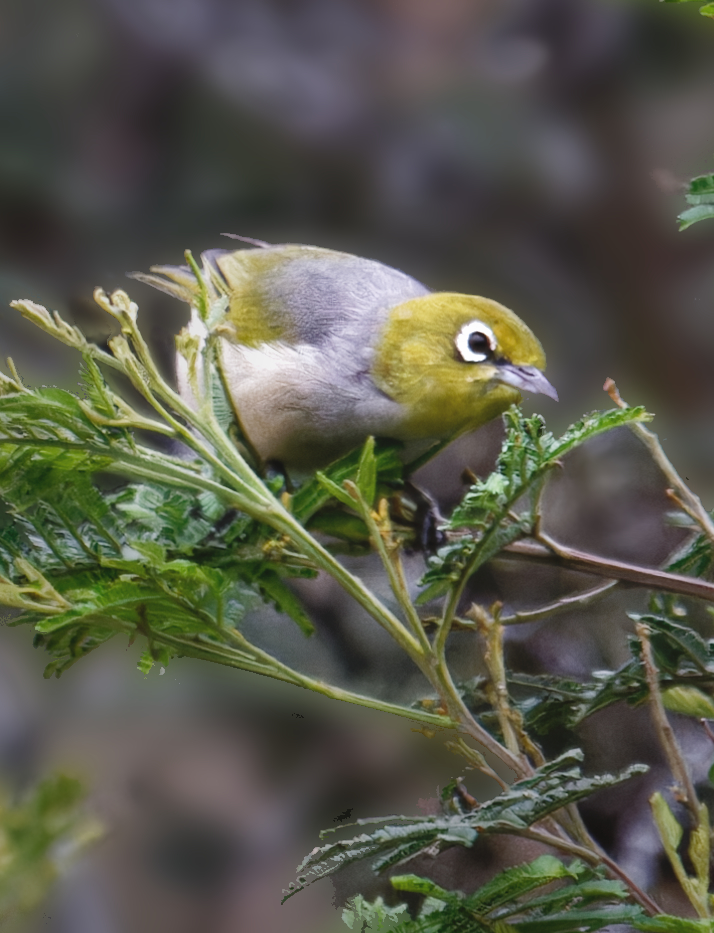
Let's have a go at photographing smaller, faster, much more skittish, and more distant birds...
This is a Silvereye, (although sometimes called a wax eye or white eye) This little one, like it's brothers and sisters, are identified by the white ring around it's eye, and green/grey/silver plumage.
When it's not frustrating the heck out of photographers due to it's constant flitting about and hiding in the dense foliage, (autofocus was no help here) it loves to find insects and nectar to eat. If you have a cherry tree with a cherry slug problem, a small family of these will fix that issue up, with no issue. That said, they're not above eating softer fruits too, particularly berries, figs, and overripe fruits (perhaps with insects) that would normally be harder.
They're reasonably common in the area, but it was nice to see them on a more secluded area.
Sorry about the softness, I found that I'd left a smear of sunscreen on my lens.

Ok, so it's not an Eagle as we originally thought...
Please forgive me, it was a long way up, and the light wasn't great to my aging eyes. This is a heavily cropped image, even after taken at an effective focal length of 640mm (12.8x optical zoom). Even then, the bird isn't taking up much area of this scene.
I've been comparing local raptors (as all eagles, harriers, falcons, kites, owls, etc. are), and I believe it's a Whistling Kite.
I did find one sittng on a branch (much lower) but it was about the same distance away along the ground. Now bear in mind, I was in a car, on a gravel road, and let's face it, the bird is interested in the current hunt, or at least, ensuring that the hunt isn't thwarted by a bumbling human armed with a camera or two. It's times like these I can see why photographers sit in hides and wait hours, days, weeks, and even months to get those amazing "National Geographic" grade images.
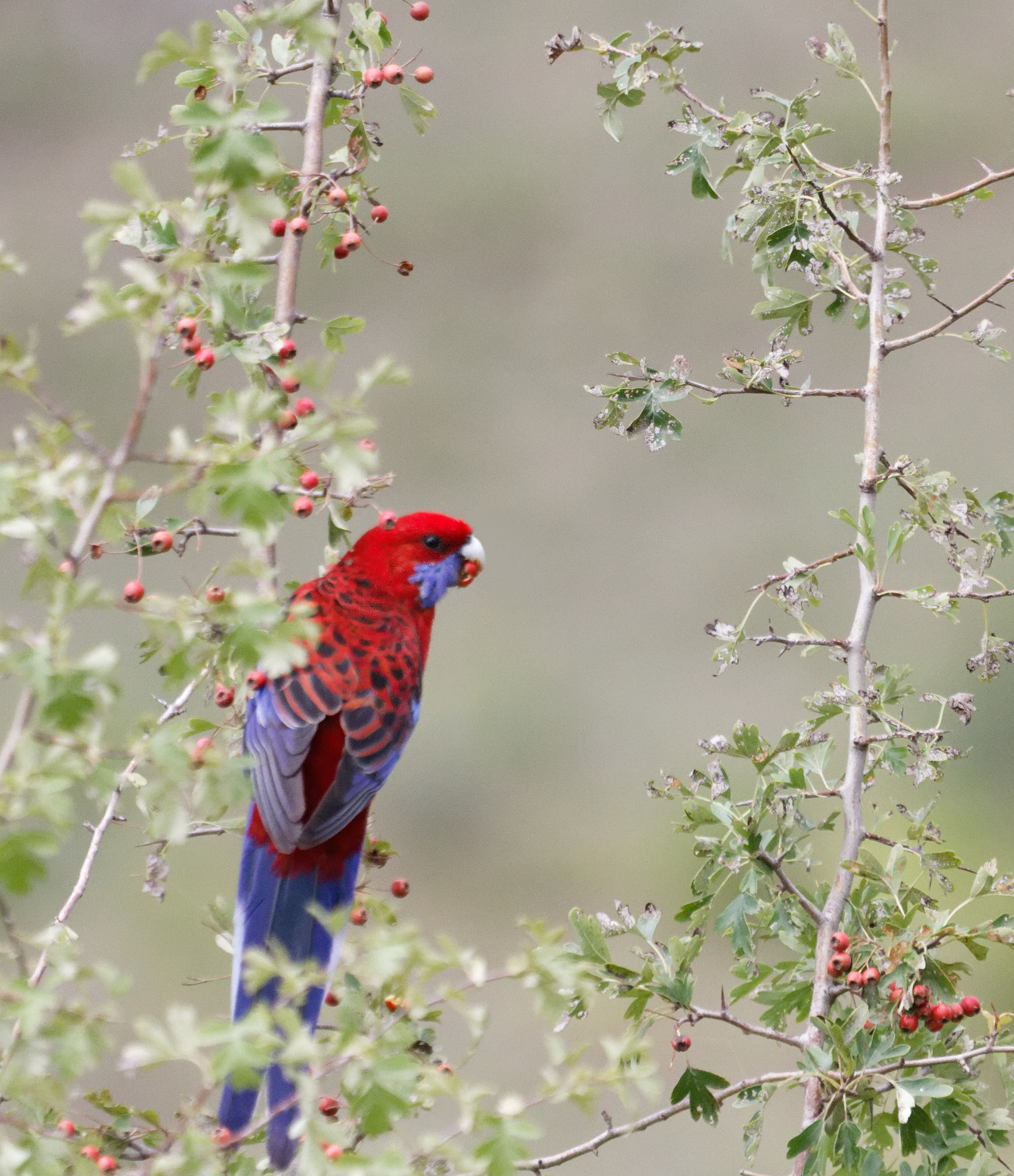
Turning around & heading past the Rosellas again...
Skipping the fruit trees for a moment, I was casually looking out over some scruffy bushes, noting the colour of the berries and idly wondering "just how poisonous are those?" Then I see this guy, happily munching away on them. The car was doing... 15-20Km/h (about 10-12Mi/h) but I managed to snap this one off while both keeping the Rosella in the frame and managing to get a single specific focal point on the Rosella's back.
To do that, I had to use a rather noisy ISO setting, so I ran this through a noise reduction app (Nik Collection's "Define") to clean that up a bit.

A wild Echidna, looking for ants to eat
These walking caltrops are common in Australia, but I can go years between sightings of wild ones. This one is a young adult at roughly 40cm long, and 30cm wide, and about 22cm high at the peak of the spines. The spines are directional, so you could brush your hands over backwards, (like a cat), but those claws are often overlooked, can rip termite mounds and brick rendering apart like tissue paper, and can be very sharp. Like a lot of Aussie wildlife, these guys are all muscle and spines, weighing in (depending on species) between 2.5 and 10Kg (about 5.5-22 pounds).
While they have spines like the Porcupine found in the U.S., Porcupines are part of the rodent family, whereas all four species of Echidna are part of the monotreme family, which are basically egg-laying mammals. Echidna's are much closer to the platypus, which is the only other living monotreme species around today.
One of my earliest memories was finding an Echidna in the middle of another country road. In order to get it to safety, we tossed a leather welding jacket from the back of the ute (pickup truck) over the Echidna for safe handling, picked it up, and took it somewhere safer.
That was some decades now, and I'd like to think maybe this is a relative, distant as it may be.
I couldn't have asked for a better photographic subject. It was on the side of the road, completely ignoring us as it was happily eating ants and other insects found in the undergrowth, in that regard, it's like the Numbat, Anteaters, Pangolin, and Aarvarks found around the world.. in terms of diet.
This Echidna also decided to amble across the road, which we stayed to ensure it got across safely.

Hiding, in the scrub....
Wallaroo (small kangaroo that is wallaby-sized when fully grown), complete with joey sticking it's head out of the pouch. Unfortunately there was some grass in front of the joey's face, but it's clearly there.
Yes, young joeys will crawl back into the pouch once they've come out, it's a lot like a bouncing, furry safe place. Sometimes you see two legs and/or a tail sticking out because they do dive back in head first.
A friend of mine has numerous rescued kangaroos on their farm, so they have a number of sewn, fur-lined "pouches" around the wood fire for the motherless joeys to crawl into when they sleep during winter. One Joey was named after "yours truly", Hamish. He lived for a couple of years on the farm, then bounded off as an adult into the wilds.
What about self-delivering Fudge? A final story....
Imagine you're heading home, and you see in the distance, something on the road....
So you crawl forward in the car, and as you get closer, a tan Dachshund starts scampering along the road toward you.
That's what happened to us! Now I'm sorry, I don't have any photos because we were packed up and busy dealing with the developing situation.
So Ren opens up the car door and this dog literally hops in, and immediately makes themself comfortable on the back seat. Clearly this dog is no stranger to car travel, and has been trained by someone.
Looking at her collar, we find that this pup is named Fudge, (a good name for a tan/chocolate brown pooch) and helpfully, there was a mobile phone number on it. She'd literally delivered herself without any issues whatsoever, and we didn't have to chase this pup at all.
Naturally, we called the number, only to find that the message bank is full.
I retract that helpful comment. What to do with Fudge?
So we found the nearest farm house (she can't be too far from home, right?), and ask if they know if Fudge belongs to a neighbour. After much discussion, and Fudge growling at the other dogs on this farm, the people seemed confident that Fudge belonged to someone they knew. So we left Fudge with them.
At least we got Fudge off the road and someone keeping an eye on her. We didn't want to take her all the way back to town, get the microchip read at the local vet, then head all the way back out on a late weekend afternoon near a sleepy country town.
All of these sights and odd events happened in a 4Km (2.5mi) stretch of road.
So to sum up...
When you're looking at a situation where you just don't know what to expect, Renee and I basically defaulted to our respective telephoto zoom lenses.
Ren was using her latest gen (at the time of writing) Canon R5 II, with the EF lens adaptor, and Sigma 150-500mm lens.
Meanwhile, I was running my first generation Canon 100-400 lens on a my first-generation Canon 7D.... both of which are quite old (decade plus) now.
Renee's gear, despite the longer lens, was actually (from an effective focal length view), shorter due to me using a crop factor camera multiplying my 400mm lens to 640mm. However, Ren has nearly three times the resolution and much more intelligent autofocus, so was not only focussed more often, but could crop the resulting images much more than I could without sacrificing detail. The newer sensor is also much less noisy, so there's less post processing to be done.
That said... Her rig is about $7000, even with the old lens. Meanwhile, my rig is currently priced at about $1200.
Here's something to think about...
Most of Ren's professional work, ends up online, to sell houses and products or show scenes and people on social media. Most images of hers, end up at at the same resolutions for easy and fast transfers over the internet as mine do shown here.
Yes, she has an easier time using the newer equipment. However, with everyone using shiny new equipment in a world full of people claiming to be "professional grade photographers" and A.I. nipping at the heels of everyone... the sad fact is, that photographic skill and emotional engagement with the subjects has never been more important in photography... particularly if you want to make it a career.
Similarly, I want you to look at my images, and ask yourself... "Does it get the scene conveyed, do the pictures together, tell a story?"
The moral of this story that I want to impart here is this:
You don't need new gear to take great photos. Sure it always helps, but it's not the end, it's the means. That said, the new software certainly helps, and I've used DXO Photolab for my raw corrections and Affinity for the touch ups.
So I'm using old gear, without a single Adobe app in sight, and yes I'm somewhat anachronistic, and distrustful of cloud apps. Guilty as charged! Yet this is a completely serviceable result if you're willing to hone your craft. I'm sure in time, I'll upgrade too.. but I don't feel the impetus merely for "keeping up with the Jones' or Ren in this case.
I'm not quite so dedicated to go back to film, but using old gear does encourage careful consideration of each and every shot you take. However, using the kind of gear I am now, and being more selective in my shots, I'm definitely seeing more careful compositions, less time in post processing, and better field craft (getting closer without disturbing animals before I get the shot).
The Sunday drive is a great way to improve photography skills, and it's reasonably affordable.
I hope this helps you with your photography!
Ham.